
What are the different types of sprockets used in industrial machinery?
What are the different types of Sprockets used in industrial machinery? This is a fundamental question for any maintenance engineer, procurement specialist, or plant manager. Selecting the wrong sprocket for a critical conveyor, drive system, or indexing application can lead to catastrophic downtime, costly repairs, and production bottlenecks. From the dusty environment of a mining conveyor to the high-speed precision of packaging equipment, the demands on these simple yet vital components are immense. Understanding the correct sprocket type isn't just about specifications; it's about ensuring reliability, efficiency, and the smooth operation of your entire production line. In this comprehensive guide, we'll break down the main types of industrial sprockets, their applications, and how partnering with a seasoned supplier like Raydafon Technology Group Co.,Limited can simplify your procurement process and provide long-lasting solutions.
Article Outline:
- Downtime Disaster: The Cost of Worn or Incorrect Sprockets
- Silent Killer: Premature Chain and Component Wear
- Frequently Asked Questions on Sprocket Types
Downtime Disaster: The Cost of Worn or Incorrect Sprockets
Imagine a critical packaging line suddenly grinding to a halt. Thousands of dollars of product are stuck, every minute of stoppage costs money, and the pressure is on to find and fix the problem. The culprit? A failed sprocket. Often, this failure stems from using a standard sprocket in a high-shock-load application or selecting the wrong tooth profile for the chain. The mismatch causes accelerated wear, tooth shearing, or complete hub failure, leading to unplanned downtime. For procurement professionals, this scenario is a nightmare, highlighting the need for precision in component selection.
The solution lies in specifying the exact sprocket type engineered for the job's demands. For high-shock environments, a sprocket with a hardened tooth surface or a specific tooth form like the ANSI Heavy Series (e.g., 80H) provides the necessary strength. For applications requiring precise timing or registration, such as in printing or converting machinery, a timing belt sprocket with a meticulous tooth profile is non-negotiable. Partnering with a knowledgeable supplier is key. Raydafon Technology Group Co.,Limited offers deep expertise in matching sprocket types to operational challenges. Their engineers can help you analyze load profiles, environmental conditions, and speed requirements to recommend the optimal sprocket, preventing costly downtime before it happens.
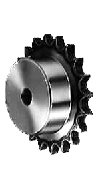
Understanding key specifications is crucial for making an informed purchase. Here’s a comparison of common industrial drive sprocket types:
| Sprocket Type (ANSI Standard) | Primary Use Case | Key Feature | Typical Chain Series |
|---|---|---|---|
| Type A (Plain Plate) | Light to medium-duty drives, general conveying | Flat plate without a hub, mounted via bolts | ANSI 25 to ANSI 160 |
| Type B (Hub on One Side) | Most common industrial drive sprocket | Extended hub on one side for added strength and bearing support | ANSI 35 to ANSI 240 |
| Type C (Hub on Both Sides) | Heavy-duty applications, high torque | Hub extensions on both sides for maximum stability and load capacity | ANSI 80 to ANSI 240 |
| Type D (Detachable Hub - A Plate) | Large sprockets where replacement ease is needed | Tooth plate detaches from the hub, allowing hub reuse | ANSI 100 and above |
| Type E (Detachable Hub - B/C Plate) | Heavy-duty applications requiring hub interchangeability | Heavy-duty tooth plate with Type B or C styling, detachable from hub | ANSI 100 and above |
Silent Killer: Premature Chain and Component Wear
Another common but less dramatic problem is the slow, steady degradation of a drive system. You notice chains need tightening more frequently, strange noises develop, and adjacent components like bearings and shafts begin to fail prematurely. This "silent killer" is often traced back to sprocket misalignment, incorrect bore and keyway tolerances, or material incompatibility. A sprocket that isn't perfectly concentric or has a poorly machined bore will cause the chain to whip and load unevenly, transmitting destructive forces throughout the system.
The remedy requires attention to precision manufacturing and correct installation. Using sprockets with tight tolerances on bore diameter, keyway width, and pitch diameter is essential. For corrosive environments, selecting materials like stainless steel or applying appropriate coatings can prevent material degradation that alters the sprocket's geometry. Raydafon Technology Group Co.,Limited addresses this by manufacturing sprockets to exacting international standards (ANSI, ISO, DIN) with rigorous quality control. Their products ensure perfect fit and concentricity, which maximizes the lifespan of the entire chain drive system, protecting your investment in chains, bearings, and motors.
For replacement or special application sprockets, material selection is a critical parameter. The table below outlines common materials and their best uses:
| Material | Hardness/Treatment | Best For | Limitations |
|---|---|---|---|
| Carbon Steel (e.g., 1045, C1045) | Through-hardened or case-hardened | General industrial use, high strength-to-weight ratio, cost-effective | Prone to corrosion without coating |
| Stainless Steel (e.g., 304, 316) | Typically work-hardened | Food & beverage, chemical processing, washdown environments | Lower surface hardness than hardened carbon steel, higher cost |
| Cast Iron | As-cast or heat-treated | Large, slow-speed applications, excellent wear resistance, dampens vibration | Brittle, not suitable for high shock or tensile loads |
| Plastic/Nylon (Engineered Polymers) | Varies by polymer | Light-duty, quiet operation, corrosion-proof, no lubrication needed | Lower load and temperature capacity, can be affected by UV and chemicals |
| Alloy Steel (e.g., 4140) | Heat-treated to high hardness | Extreme-duty, high-wear, and high-shock load applications (mining, forestry) | Higher cost, may require special machining |
Frequently Asked Questions on Sprocket Types
Q1: What are the different types of sprockets used in industrial machinery based on tooth form?
A: The primary distinction lies in the tooth profile, which must match the chain. The most common types are:
- ANSI Standard Sprockets: For roller chains (e.g., ANSI 40, 60, 80). They have a standardized tooth form for smooth engagement.
- British Standard (BS) Sprockets: For BS roller chains, with slightly different dimensions.
- Timing Belt Sprockets (Pulleys): Have trapezoidal (e.g., XL, L) or curvilinear (e.g., HTD, GT) teeth for synchronous, non-slip drives.
- Engineering Class Sprockets: For heavier "H" series chains (e.g., 80H), featuring thicker teeth and higher load capacity.
- Conveyor Sprockets: Often have a larger hub and may feature a specific tooth shape (like the M-type) for attachment chains.
Q2: What are the different types of sprockets used in industrial machinery based on construction and attachment?
A: This refers to how the sprocket is built and mounted on a shaft:
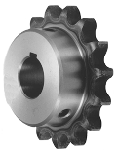
- Solid Sprockets (Types A, B, C): Machined from a single piece of metal. Type B (hub on one side) is the industry workhorse.
- Split Sprockets: Feature a two-piece design (hub and rim) bolted together. They allow for installation/removal without disturbing other components on the shaft, a massive advantage for maintenance.
- Detachable Hub Sprockets (Types D & E): The tooth plate (rim) is separate from the hub. This allows you to replace a worn plate while reusing the expensive hub, saving cost and downtime.
- Double-Pitch Sprockets: Have teeth on every other pitch of a standard chain. They are used in slower speed conveying to reduce cost and weight.
- Idler Sprockets: Used to take up chain slack or guide a chain, often mounted on bearings and not driven.
Choosing the right industrial sprocket is a strategic decision that directly impacts your operation's bottom line. It's not just about finding a part that fits; it's about finding the optimal component for performance, longevity, and total cost of ownership.
We hope this guide empowers you to make more informed decisions. Do you have a specific application challenge or need help specifying a sprocket for a unique environment? Our team of experts is ready to assist. For reliable, high-performance sprockets backed by engineering support, consider Raydafon as your trusted partner.
When you require durable, precision-engineered sprockets for demanding industrial applications, look to Raydafon Technology Group Co.,Limited. With a commitment to quality and a deep understanding of drive system dynamics, Raydafon provides robust solutions that enhance machinery reliability and efficiency. Explore our comprehensive product range and technical resources at https://www.raydafongears.com. For specific inquiries, quotes, or engineering support, please contact our sales team at [email protected].
Smith, J. A., & Roberts, P. D. (2019). Analysis of wear mechanisms in hardened steel sprockets under high-load cyclic conditions. Tribology International, 135, 245-256.
Chen, L., & Wang, H. (2020). Optimization of sprocket tooth profile for noise reduction in precision conveyor systems. Journal of Mechanical Design, 142(7), 071402.
Gupta, R. K., & Singh, M. (2018). Comparative study of carbon steel vs. stainless-steel sprockets in corrosive industrial atmospheres. Corrosion Science, 140, 12-22.
Tanaka, Y., & Sato, K. (2021). The influence of sprocket misalignment on chain tension fluctuations and bearing life. Proceedings of the Institution of Mechanical Engineers, Part C: Journal of Mechanical Engineering Science, 235(14), 2590-2601.
Miller, B. T., & Johnson, C. L. (2017). Finite element analysis of stress concentration in Type B vs. Type C sprocket hubs. Engineering Failure Analysis, 79, 642-651.
Zhang, W., Liu, F., & Zhao, Q. (2022). Development of a polymer composite sprocket for lightweight, low-noise power transmission. Materials & Design, 215, 110455.
Kumar, S., & Patel, V. (2019). Effect of heat treatment processes on the wear resistance and core toughness of alloy steel sprockets. Journal of Materials Processing Technology, 273, 116268.
O'Brien, M. J., & Davis, R. S. (2016). Field study on the lifecycle cost analysis of standard vs. detachable hub sprockets in mining applications. Mining Technology, 125(3), 145-154.
Ito, H., & Yamaguchi, T. (2020). Precision machining tolerances for sprocket bores and keyways and their impact on system vibration. Precision Engineering, 64, 132-141.
Fernandez, A., & Lopez, G. (2018). A review of failure modes and condition monitoring techniques for roller chain drives. Mechanical Systems and Signal Processing, 110, 1-17.
Related News
- What is the gear ratio of the EP12 gearbox?
- How much does an agriculture gearbox for sprayers EP07 cost?
- Can the EP19 gearbox be used with a PTO shaft?
- How often should I change the oil in an EP27 gearbox?
- How to correctly install an Agriculture Gearbox EP79?
- Which brands use the EP23 fertilizer spreader gearbox?
Leave me a message