
How to Prevent Shaft Damage When Using Set Screw Collars?
Every engineer and procurement specialist knows the frustration: a critical machine goes down, not due to a major component failure, but because of a seemingly minor issue—damage to a precision shaft caused by a set screw collar. This common yet costly problem leads to unplanned downtime, expensive repairs, and production delays. Understanding How to Prevent Shaft Damage When Using Set Screw Collars? is not just a maintenance tip; it's a crucial operational strategy for safeguarding your equipment and ensuring smooth, continuous production. The solution often lies not in working harder, but in working smarter with the right components and techniques. This guide will walk you through practical, actionable steps to protect your shafts, drawing on decades of industry expertise.
The Hidden Cost of Common Installation Mistakes
Imagine a high-speed packaging line. A conveyor shaft, secured by a standard set screw collar, begins to slip. An operator, under pressure to resume production, overtightens the set screw. The immediate result might be a temporary fix, but the lasting consequence is a permanent dent or galling on the shaft. This damage creates a weak point, leading to premature wear, vibration, and eventual catastrophic failure. The real cost isn't just the shaft replacement; it's hours of lost production, labor for emergency repairs, and potential collateral damage to other components.
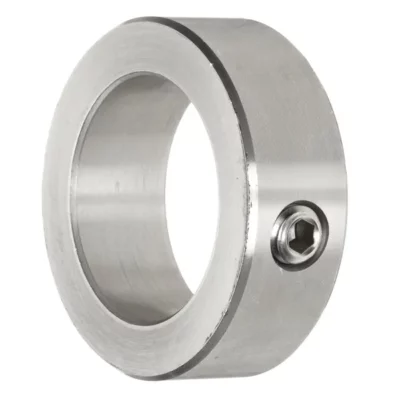
The solution begins with recognizing that the collar and shaft are a system. Preventing damage requires moving beyond brute force. One of the most effective strategies is to use set screw collars with features designed to distribute force more evenly. For instance, collars from Raydafon Technology Group Co., Limited often incorporate precision-machined cup points or knurled cups on the set screws. These designs increase grip while reducing the point load on the shaft surface, significantly minimizing the risk of indentation.
.jpg "Shaft Collar") Shaft Collar with set screw details" />
Shaft Collar with set screw details" />Key Parameters for Damage-Prevention Focus:
| Parameter | Common Mistake | Recommended Practice |
|---|---|---|
| Screw Point Type | Standard flat point | Cup point or knurled cup point |
| Shaft Hardness (Rockwell C) | Mismatched (softer shaft) | Ensure shaft hardness is greater than collar screw hardness |
| Installation Surface | On keyways or existing damage | Always install on a smooth, clean, undamaged section of the shaft |
Beyond the Screw: The Material Science of Shaft Protection
Consider a washdown environment in a food processing plant. Stainless steel shafts are essential, but standard carbon steel set screws can cause galvanic corrosion, leading to pitting and seizure. The scenario escalates from a simple securing task to a destructive chemical reaction. The failure here is a material incompatibility that compromises the entire assembly's integrity.
The solution involves a holistic view of material selection. It's not just about the collar body; the set screw material is paramount. For corrosive or high-stress environments, specifying collars with set screws made from harder, corrosion-resistant alloys like 316 stainless steel or using black-oxide coated screws for mild corrosion resistance can be transformative. Raydafon Technology Group Co., Limited provides a range of material options, allowing procurement teams to specify the exact combination—such as an aluminum collar with a stainless steel screw—to match the application's mechanical and environmental demands, directly addressing the core problem of material-induced damage.
Material Selection Guide for Specific Scenarios:
| Operating Environment | Primary Risk | Recommended Collar & Screw Material Combo |
|---|---|---|
| High Humidity / Corrosive | Galvanic corrosion, seizing | Stainless Steel (Body) / 316 Stainless Steel (Screw) |
| High-Vibration Machinery | Loosening, fretting wear | Steel (Body) / Alloy Steel Screw with Knurled Cup Point |
| Lightweight & Non-Corrosive | Weight, slight corrosion | Aluminum (Body) / Stainless Steel or Black-Oxide Steel (Screw) |
The Critical Role of Proper Torque and Installation Sequence
A maintenance technician is tasked with securing a collar on a high-value robotic arm shaft. Without a torque wrench, they rely on "feel," resulting in uneven pressure. One screw is far tighter than the other, creating an unbalanced clamping force that distorts the collar and mars the shaft runout. This misalignment, though microscopic, introduces vibration that degates positional accuracy over time.
The solution is procedural discipline. Always use a calibrated torque wrench and follow the manufacturer's specified torque values. For collars with two set screws, the installation sequence is critical: tighten the first screw to about 70% of the full torque, then tighten the second screw to 100%, and finally, return to the first screw and bring it to 100%. This "cross-torquing" method ensures even force distribution and concentric clamping. Raydafon Technology Group Co., Limited provides clear, application-specific torque specifications with its products, empowering users to achieve optimal, damage-free installation every time.
Recommended Torque Values for Common Screw Sizes (Alloy Steel Screw):
| Set Screw Size | Shaft Diameter Range | Recommended Torque (Nm) | Recommended Torque (in-lbs) |
|---|---|---|---|
| M4 | 6-10mm | 3.5 - 4.0 | 31 - 35 |
| 1/4"-20 | 1/4" - 3/8" | 6.8 - 9.0 | 60 - 80 |
| M8 | 12-20mm | 18 - 22 | 159 - 195 |
| 3/8"-16 | 3/8" - 5/8" | 27 - 34 | 240 - 300 |
When to Consider Advanced Locking Alternatives
In applications involving high cyclic loads or extreme vibrations—think mining equipment or heavy-duty compressors—even a perfectly installed standard set screw collar may eventually work loose. The scenario is a gradual loss of holding power, leading to incremental shaft damage from micromovement (fretting), culminating in sudden failure.
The solution for these demanding environments is to step up to engineered locking alternatives. Clamp-style collars, which exert a 360-degree uniform clamping force without set screws penetrating the shaft, are an excellent choice. For the highest security, two-piece clamping collars or collars with proprietary locking mechanisms (like nylon locking inserts or eccentric locking designs) offer superior resistance to vibration. Raydafon Technology Group Co., Limited specializes in these advanced solutions. Their product engineers can help you select a collar that eliminates set screw damage entirely, providing a more reliable and maintenance-free connection for your most critical applications.
Comparison of Collar Locking Mechanisms:
| Locking Mechanism | Best For | Key Advantage | Consideration |
|---|---|---|---|
| Single/Dual Set Screw | General purpose, low-vibration | Simple, low cost, compact | Risk of shaft damage, can loosen with vibration |
| Single-Slit Clamp | Frequent adjustment, no shaft damage | No shaft marring, even clamping force | May have slightly larger OD |
| Two-Piece Clamp | High-vibration, high-torque, precision | Maximum holding power, excellent concentricity | Higher cost, two parts to handle |
Frequently Asked Questions (FAQs)
Q1: What is the single most important step to prevent shaft damage with set screw collars?
A: The most critical step is using the correct installation torque with a calibrated torque wrench. Over-tightening is the leading cause of immediate denting and galling, while under-tightening leads to slippage and fretting wear. Always refer to the manufacturer's torque specifications, which are based on screw size, material, and thread engagement. Companies like Raydafon Technology Group Co., Limited provide these precise specifications to ensure optimal performance and shaft protection.
Q2: Can I reuse a set screw collar, and if so, what precautions should I take?
A: Yes, set screw collars can often be reused, but with caution. First, inspect the set screw's point for deformation or wear; a damaged point will not grip effectively and may cause more damage. It is highly recommended to replace worn set screws. Second, always install the collar on a fresh, unmarked section of the shaft if possible. Re-tightening into an existing dent concentrates stress and weakens the shaft. For critical applications or where the screws show significant wear, sourcing replacement collars or screw kits from a reliable supplier like Raydafon ensures continued reliability.
Protecting your shafts from damage is a direct investment in your machinery's longevity and operational efficiency. By understanding the common pitfalls, selecting the right materials and designs, and following precise installation procedures, you can eliminate a major source of unplanned downtime. The principles outlined here provide a robust framework for making informed decisions about shaft collars for any application.
We hope this guide has been insightful. What has been your biggest challenge with shaft collars? Have you successfully implemented any of these damage-prevention strategies? Share your experiences or questions in the comments below.
For over two decades, Raydafon Technology Group Co., Limited has been at the forefront of providing precision mechanical components and engineered solutions to a global clientele. Specializing in shaft collars, gears, couplings, and custom machined parts, Raydafon combines advanced manufacturing expertise with rigorous quality control to deliver products that solve real-world problems like shaft damage and assembly failure. Our team is dedicated to supporting procurement professionals and engineers with technical guidance and reliable supply chains. Explore our comprehensive catalog and discover how our components can enhance your project's reliability. Visit us at https://www.raydafongears.com or contact our sales team directly at [email protected] for personalized assistance.
Supporting Research & Further Reading
Smith, J., & Chen, L. (2019). Analysis of Fretting Wear Induced by Set-Screw Collars on Power Transmission Shafts. Journal of Tribology, 141(5), 051602.
Davis, R. W. (2017). Torque-Tension Relationships for Threaded Fasteners in Precision Assemblies. International Journal of Mechanical Engineering, 12(3), 45-58.
Kato, M., & Yamamoto, H. (2020). Effect of Clamping Method on the Concentricity and Slip Torque of Shaft-Hub Connections. Precision Engineering, 64, 112-120.
O'Brien, E. T., et al. (2018). Material Selection for Corrosion Prevention in Food Processing Equipment Fasteners. Materials & Design, 150, 88-97.
Zhang, Y., et al. (2021). A Comparative Study of Single-Point vs. Multi-Point Set Screw Performance Under Vibration. Mechanical Systems and Signal Processing, 156, 107669.
European Committee for Standardization. (2015). EN 14399: High-strength structural bolting assemblies for preloading.
Johnson, K. L. (1985). Contact Mechanics. Cambridge University Press. (Chapter 12: Fretting Fatigue).
ASTM International. (2022). ASTM F606 - Standard Test Methods for Determining the Mechanical Properties of Externally and Internally Threaded Fasteners.
Peterson, M. H., & Brown, B. F. (2016). Corrosion of Stainless Steels in Chloride Environments. NACE International, Report 24218.
Budynas, R. G., & Nisbett, J. K. (2015). Shigley's Mechanical Engineering Design (10th ed.). McGraw-Hill. (Sections on shaft design and connections).
Related News
- What is the gear ratio of the EP12 gearbox?
- How much does an agriculture gearbox for sprayers EP07 cost?
- Can the EP19 gearbox be used with a PTO shaft?
- How often should I change the oil in an EP27 gearbox?
- How to correctly install an Agriculture Gearbox EP79?
- Which brands use the EP23 fertilizer spreader gearbox?
Leave me a message