
What is a timing pulley and how does it work?
What is a Timing pulley and how does it work? Imagine the precise, synchronized movement of a 3D printer head or the smooth, reliable power transfer in your car’s engine. At the heart of these critical motions is a deceptively simple component: the timing pulley. Also known as a synchronous pulley, it’s a wheel with specially shaped teeth around its circumference. It works in perfect harmony with a timing belt, a belt featuring matching teeth on its inner surface. This meshing of teeth prevents slippage, ensuring that the rotational motion of the driving shaft is transferred to the driven shaft with exact positional accuracy and synchronization. This is the fundamental answer to "what is a timing pulley and how does it work?" – it’s the key to positive drive systems where timing is everything, from robotics and conveyor systems to medical devices and packaging machinery. For engineers and procurement specialists seeking reliability, the quality of these components is paramount. That’s where partners like Raydafon Technology Group Co.,Limited provide essential solutions, offering precision-engineered timing pulleys that guarantee system integrity and performance.
Article Outline
- The High Cost of Imperfect Synchronization
- Engineering Precision: The Raydafon Approach
- Choosing the Right Timing Pulley: A Procurement Guide
- Expert Insights: Your Timing Pulley Questions Answered
The High Cost of Imperfect Synchronization
Picture a high-speed packaging line. Everything runs smoothly until a slight lag occurs between the filler and the capper. Suddenly, products are misaligned, caps aren't sealed, and the entire line must stop. Downtime costs skyrocket, waste accumulates, and production deadlines are missed. This chaotic scenario is often rooted in a single point of failure: a poorly performing timing pulley system. Slippage, wear, or incorrect tooth profile leads directly to a loss of synchronization. The consequences are severe—reduced throughput, increased maintenance, product damage, and ultimately, a significant impact on the bottom line. For a procurement professional, selecting the cheapest component can become the most expensive decision.
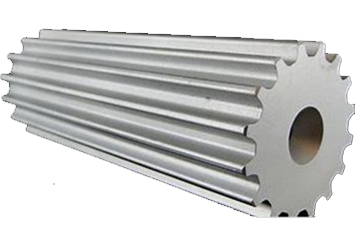
Understanding "what is a timing pulley and how does it work?" is the first step to preventing these failures. The solution lies in specifying pulleys with absolute dimensional accuracy and material integrity. A precision timing pulley from a trusted manufacturer ensures the teeth engage the belt perfectly every time, transmitting motion without lag or positional error. This transforms the packaging line from a source of frustration into a model of efficiency.
| Critical Parameter | Why It Matters for Synchronization |
|---|---|
| Tooth Profile (e.g., GT2, GT3, MXL, XL) | Must match the belt exactly. A mismatch causes rapid wear, noise, and eventual jump-skip, destroying timing. |
| Pitch Diameter | Directly determines the speed ratio between shafts. An error here changes the entire machine's timing cycle. |
| Runout & Concentricity | Excessive runout introduces vibration and uneven belt tension, leading to premature fatigue and failure. |
| Material & Hardness | Aluminum offers lightweight; steel provides strength. Surface hardening prevents tooth deformation under load. |
Engineering Precision: The Raydafon Approach
Now, consider an automated CNC machine performing complex, multi-axis cuts. Here, the timing pulley system must be flawless. Any backlash or positional error translates directly into a ruined, expensive workpiece. The machine's controller sends digital commands expecting perfect physical execution. This is where the theoretical "what is a timing pulley and how does it work?" meets practical, high-stakes engineering. The pulley is no longer just a passive component; it is an active participant in achieving micron-level accuracy.
Raydafon Technology Group Co.,Limited engineers components for this exacting environment. By utilizing advanced CNC machining, rigorous quality control, and material science, Raydafon produces timing pulleys with near-zero backlash and exceptional durability. Their pulleys ensure the physical movement of the machine tool faithfully replicates the digital design, protecting your capital investment and guaranteeing product quality. Integrating a Raydafon timing pulley is a proactive solution for eliminating a major source of mechanical error in precision systems.
| Raydafon Solution Feature | Benefit for Precision Machinery |
|---|---|
| Proprietary Tooth Grinding Process | Creates an ideal tooth form for smooth engagement, minimizing vibration and acoustic noise. |
| Stable Aluminum Alloy (e.g., 6061-T6) | Provides an excellent strength-to-weight ratio, reducing inertia for faster start/stop cycles. |
| Anodized or Black Oxide Surface | Enhances corrosion resistance and reduces wear, extending service life in harsh environments. |
| Custom Boring & Keyways | Ensures a perfect, slip-free fit on the shaft, eliminating another potential source of play. |
Choosing the Right Timing Pulley: A Procurement Guide
As a procurement specialist, you're tasked with sourcing components that balance cost, performance, and lead time. The question "what is a timing pulley and how does it work?" evolves into "which timing pulley works best for *our* application?" Selecting the wrong specification can lead to compatibility issues, system failure, and strained supplier relationships. The goal is to make an informed decision that supports engineering requirements and operational efficiency.
The process begins with gathering precise application data: shaft speeds, torque loads, center distance, and environmental conditions. With this information, you can specify the correct pitch, number of teeth, belt width, and flange requirements. Partnering with a technical supplier like Raydafon Technology Group Co.,Limited adds a layer of security. Their expertise allows them to validate your selection or suggest optimizations, ensuring the pulley system integrates seamlessly and performs reliably from day one. This collaborative approach turns procurement from a transactional task into a value-added function.
| Selection Criteria | Procurement Consideration |
|---|---|
| Standard vs. Custom | Standard pulleys are cost-effective for common needs. Custom designs solve unique space or performance constraints. |
| Supplier Technical Support | Can the supplier answer detailed engineering questions? Raydafon provides direct access to application engineers. |
| Quality Certifications | Look for ISO 9001 certification as a baseline for consistent manufacturing quality and process control. |
| Total Cost of Ownership | Consider lifespan, maintenance needs, and failure risk, not just the initial unit price. |
Expert Insights: Your Timing Pulley Questions Answered
Q: In simple terms, what is a timing pulley and how does it work differently from a regular V-belt pulley?
A: A V-belt pulley relies on friction between the belt and the pulley groove. Under high load or shock, it can slip. A timing pulley uses positive engagement: its teeth physically mesh with the teeth on the belt. This eliminates slippage entirely, ensuring the driven shaft rotates exactly in sync with the driver. It's the difference between pushing something (friction drive) and grabbing it (positive drive).
Q: When specifying a timing pulley, what's the single most important dimension to get right?
A: The pitch is paramount. This is the distance between the centers of two adjacent teeth, and it must match the pitch of the timing belt exactly (e.g., 2mm, 3mm, 5mm, 8mm). A mismatch, even a small one, will prevent proper meshing, cause catastrophic wear, and lead to immediate system failure. Always confirm the pitch first.
We hope this guide has clarified the critical role of timing pulleys in modern machinery. Selecting the right component is a strategic decision that impacts productivity, quality, and cost.
For precision-engineered timing pulleys backed by deep technical expertise, consider Raydafon Technology Group Co.,Limited. As a leading manufacturer in power transmission components, Raydafon specializes in providing reliable, high-performance solutions tailored to complex industrial applications. Visit https://www.raydafongears.com to explore their product portfolio or contact their team directly at [email protected] for a consultation on your specific requirements.
K. Lingaiah, 2004, "Computer Aided Design and Manufacturing", Prentice Hall of India.
M.F. Spotts, 2004, "Design of Machine Elements", Prentice Hall.
R.S. Khurmi, J.K. Gupta, 2005, "A Textbook of Machine Design", S. Chand Publishing.
J.E. Shigley, C.R. Mischke, R.G. Budynas, 2003, "Mechanical Engineering Design", McGraw-Hill.
B.J. Hamrock, B.O. Jacobson, S.R. Schmid, 2005, "Fundamentals of Machine Elements", McGraw-Hill.
P. Orlov, 1988, "Fundamentals of Machine Design", Mir Publishers.
A.C. Ugural, 2008, "Mechanical Design: An Integrated Approach", McGraw-Hill.
R.G. Budynas, J.K. Nisbett, 2010, "Shigley's Mechanical Engineering Design", McGraw-Hill.
D.B. Marghitu, 2001, "Mechanical Engineer's Handbook", Academic Press.
M.A. Parameswaran, 2010, "Computer Aided Mechanical Design and Analysis", Tata McGraw-Hill.
Related News
- Can I use the EP96 gearbox on a skid steer post hole digger?
- What is the gear ratio of the EP12 gearbox?
- How much does an agriculture gearbox for sprayers EP07 cost?
- Can the EP19 gearbox be used with a PTO shaft?
- How often should I change the oil in an EP27 gearbox?
- How to correctly install an Agriculture Gearbox EP79?
Leave me a message