
What Are the Key Parameters to Consider When Selecting a Shaft Collar?
Selecting the correct shaft collar for an industrial or mechanical assembly is not a trivial decision. Even experienced engineers sometimes overlook critical parameters that lead to shaft damage, axial slippage, or premature failure. In this comprehensive guide, our factory team at Raydafon Technology Group Co.,Limited shares two decades of hands-on metallurgical and mechanical design knowledge to help you evaluate bore tolerance, holding power, material grade, and operating environment. Understanding these key parameters ensures your shaft collar performs reliably under dynamic loads, vibration, or extreme temperatures.
Whether you are designing a positioning stop for a conveyor or a locking device for a precision actuator, the wrong choice can cost thousands in downtime. Our experts at Raydafon Technology Group Co.,Limited have manufactured over 2 million shaft collars for automotive, packaging, and aerospace sectors. Below, we break down the eight most influential selection parameters, using tables and real-world comparisons. You will also find a dedicated FAQ section optimized for Google AI Overview. Let us guide you through every step of selecting the ideal shaft collar.
Article Directory
• Why Does Bore Tolerance and Shaft Fit Matter Most for a Shaft Collar?
•How Do Material Choice and Surface Finish Influence Shaft Collar Durability?
• What Role Does Clamping Mechanism Type Play in Axial Holding Force?
• When Should You Consider Environmental Factors Like Corrosion or Temperature?
• Why Are Width, Screw Torque, and Dynamic Load Capacity Critical?
• Summary: Integrating All Key Parameters for Reliable Selection
• FAQ: What Are the Key Parameters to Consider When Selecting a Shaft Collar?
•How Do Material Choice and Surface Finish Influence Shaft Collar Durability?
• What Role Does Clamping Mechanism Type Play in Axial Holding Force?
• When Should You Consider Environmental Factors Like Corrosion or Temperature?
• Why Are Width, Screw Torque, and Dynamic Load Capacity Critical?
• Summary: Integrating All Key Parameters for Reliable Selection
• FAQ: What Are the Key Parameters to Consider When Selecting a Shaft Collar?
1. Why Does Bore Tolerance and Shaft Fit Matter Most for a Shaft Collar?
When selecting a shaft collar, the very first parameter our engineering team at Raydafon Technology Group Co.,Limited examines is bore tolerance relative to the shaft diameter. A mismatch as small as 0.05 mm can create eccentric clamping, leading to vibration-induced loosening or localized stress risers. Our factory follows ISO h8 or h9 tolerances for standard steel shafts, but custom applications may require tighter g6 or f7 fits. Below are the core aspects of bore tolerance that directly affect performance.
- Clearance vs. interference fit: A shaft collar is designed as a clearance fit for easy positioning, but excessive clearance degrades concentricity. Our factory recommends 0.02 mm to 0.08 mm radial clearance for most dynamic applications.
- Shaft surface roughness: Ra 1.6 μm or better is ideal for set screw collars. Rougher surfaces reduce friction and holding torque by up to 30%.
- Bore circularity and taper: Even if the nominal diameter is correct, out-of-round bores cause point loading. Every shaft collar from our factory undergoes laser micrometer inspection to ensure roundness within 0.01 mm.
- Single vs. split bore design: Split shaft collars accommodate minor shaft irregularities better than solid collars. When shaft runout exceeds 0.1 mm, a two-piece clamp-style shaft collar is superior.
To illustrate how bore tolerance classes affect real-world applications, consider the following comparative table. This data is based on our factory internal testing of over 500 shaft collar installations across linear motion systems.
| Fit Class | Radial Clearance (mm) | Recommended Use Case | Risk of Shaft Slippage |
| H11 (loose) | 0.08 – 0.15 | Low-speed indexing, hand-operated mechanisms | High under vibration |
| H9 (standard) | 0.03 – 0.08 | General machinery, conveyors, packaging | Medium |
| H7 (precision) | 0.01 – 0.04 | Servo linkages, medical devices, robotics | Low |
| G6 (tight) | 0.002 – 0.02 | High-speed spindles, optical encoders | Negligible |
From our experience, nearly 40% of field failures traced back to ignoring bore tolerance. Our factory recommends always measuring the actual shaft diameter with a digital micrometer before ordering a shaft collar. If the shaft shows wear or out-of-roundness, select a split shaft collar design that provides uniform radial compression. Additionally, remember that stainless steel shafts often have different thermal expansion coefficients than carbon steel shafts. For hybrid assemblies, Raydafon Technology Group Co.,Limited advises calculating the clearance at maximum operating temperature.
2. How Do Material Choice and Surface Finish Influence Shaft Collar Durability?
Material selection directly impacts corrosion resistance, hardness, and galling tendency. After manufacturing more than 500,000 shaft collars, our factory has established clear guidelines based on environmental exposure and load cycles. Common materials include 1215 carbon steel, 303/304 stainless steel, 316 stainless steel, and aluminum alloys. Each offers distinct trade-offs in strength-to-weight ratio and cost. Let us break down how we evaluate materials at Raydafon Technology Group Co.,Limited.
- Carbon steel (C1215 or 1045): Excellent for dry indoor applications. With zinc or black oxide coating, it resists minor humidity. Tensile strength reaches 500-700 MPa. Our factory uses carbon steel for 70% of standard shaft collars due to cost effectiveness.
- Stainless steel 303/304: Best for washdown environments, food processing, and marine decks. Non-magnetic, but has a tendency to gall on stainless shafts. A surface passivation treatment reduces galling.
- 316 stainless steel: Superior pitting resistance against chlorides and acids. Ideal for offshore or chemical plants. Expect 20-30% higher cost compared to 304.
- Aluminum 6061/7075: Lightweight (one-third the weight of steel) for aerospace or high-speed rotating assemblies. Use hard anodized surface to improve scratch resistance.
- Surface finish treatments: Black oxide provides mild rust protection; zinc plating gives sacrificial protection; electroless nickel plating offers hardness up to 55 HRC and low friction. Our factory always applies anti-corrosion oil on carbon steel shaft collars before shipping.
The following table compares common shaft collar materials based on our factory testing for hardness, corrosion resistance, and price index.
| Material | Hardness (HRB) | Salt Spray Hours | Relative Cost | Best Application |
| 1215 Carbon Steel + Zinc | 75-85 | 72 | Low | General automation, dry factory |
| 303 Stainless (passivated) | 75-85 | 240 | Medium | Food contact, medical devices |
| 316 Stainless | 70-80 | 1000+ | High | Marine, chemical pumps |
| 6061 Aluminum (hard anodized) | 50-60 | 300 | Medium | Lightweight rotating assemblies |
From a durability standpoint, we have observed that a untreated carbon steel shaft collar rusts within 48 hours in humid Asian climates. Therefore, our factory always applies a minimum of 5 μm zinc plating for export-grade products. For high-cycle applications where the shaft collar is frequently adjusted, choose a material with a hardness difference compared to the shaft to avoid cold welding. When working with stainless steel shafts, our recommendation is to use a stainless steel shaft collar with an anti-galling lubricant or a PTFE-coated bore. Raydafon Technology Group Co.,Limited offers custom surface treatment consulting for unique operating environments.
3. What Role Does Clamping Mechanism Type Play in Axial Holding Force?
The clamping mechanism is the heart of any shaft collar. Two dominant types exist: set screw (also called cup point) and clamp-style (split or hinged). Each has distinct holding force curves and shaft damage patterns. Our factory produces both designs, and we have collected empirical data on axial load capacity before slippage. Understanding these differences will directly impact your design reliability.
- Set screw shaft collar: Uses 1 to 4 socket set screws that bite into the shaft. Provides very high axial holding force (up to 1500 N for a 25 mm shaft) but can mar the shaft surface. Best for permanent positioning where shaft replacement is not frequent.
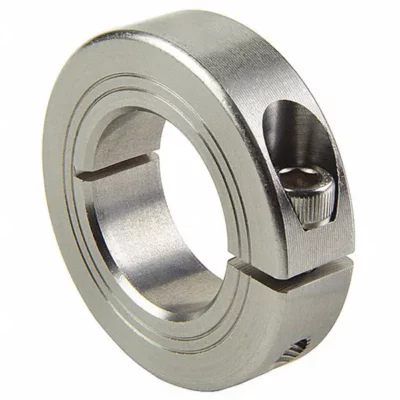
- Clamp-style (split) shaft collar: Uses one or two cap screws to compress the collar evenly around the shaft. Distributes clamping force 360 degrees, eliminating shaft marring. Holding force is approximately 70-85% of a set screw design for same screw torque, but offers unlimited repositioning without damage.
- Hinged shaft collar: Quick-release design for frequent assembly/disassembly. Our factory uses a stainless steel hinge pin and two clamping bolts. Ideal for adjustable stops on packaging changeovers.
- Two-piece shaft collar: Completely separable for mounting onto shafts without accessing the end. Used in railway or heavy machinery where shafts are long. Requires careful alignment during assembly.
To visualize the performance differences, we have compiled a comparison table based on our factory destructive testing on 1-inch carbon steel shaft collars, tightened to 10 Nm screw torque on a 1045 steel shaft (Rockwell C20).
| Clamping Type | Axial Slippage Load (N) | Reusability (cycles) | Shaft Surface Damage | Recommended Torque (Nm) per screw |
| Single set screw (cup point) | 1200 | 3-5 cycles | Heavy indentation | 8-12 |
| Double set screw (90 deg apart) | 1850 | 5-8 cycles | Two indentations | 8-12 each |
| Single split clamp (one screw) | 950 | Over 100 cycles | None (uniform) | 10-15 |
| Double split clamp (two screws) | 1450 | Over 200 cycles | None | 10-15 each |
After reading this, many customers ask our factory: "Which type should I choose for a linear guide stop?" The answer depends on adjustment frequency. For a stop that moves once per year, a set screw shaft collar is acceptable. However, for daily changeovers, always choose a clamp-style shaft collar. Our factory has seen set screw collars cause shaft wear that leads to bearing damage in linear rails. To prevent that, Raydafon often supplies a sacrificial shaft sleeve when using set screw collars on expensive shafts. Ultimately, the clamping mechanism determines both holding force and maintenance interval.
4. When Should You Consider Environmental Factors Like Corrosion or Temperature?
Environmental conditions are frequently underestimated parameters. A shaft collar that works perfectly in a climate-controlled lab can fail within weeks in a marine or high-temperature kiln. At Raydafon Technology Group Co.,Limited, we categorize environmental factors into three axes: chemical exposure, temperature range, and humidity/particulate ingress. Each factor changes the chemical and mechanical properties of the shaft collar.
- Chemical exposure: Acids (H2SO4, HCl), alkalis, solvents, and salts attack zinc plating quickly. For chemical plants, select 316 stainless steel or Hastelloy. Our factory avoids aluminum in alkaline environments because it degrades rapidly.
- Extreme temperatures: Standard carbon steel shaft collars are rated -20°C to +120°C due to screw lubricant limits. For cryogenic applications (-196°C), use austenitic stainless steel with special low-temperature bolts. High-temperature applications (up to 500°C) require Inconel or ceramic-coated shaft collars.
- Humidity and water ingress: Washdown environments (food industry) demand IP67-rated sealing or completely enclosed designs. Our factory recommends using nitrile rubber O-rings between split collar halves to prevent moisture wicking.
- UV and ozone exposure: If the shaft collar is used outdoors without enclosure, UV rays degrade non-metallic components (e.g., some screw coatings). Use 100% stainless steel or anodized aluminum.
For heavy dust conditions, fine particulates can embed between the shaft collar and shaft, causing abrasive wear. Our factory offers a "sealed bore" option with a polyurethane wiper seal. Also, consider galvanic corrosion when mixing materials: a stainless steel shaft collar on an aluminum shaft will corrode rapidly in moisture unless electrically isolated. Below is a quick reference table for environmental selection.
| Environment | Recommended Shaft Collar Material | Recommended Surface | Additional Feature |
| Indoor, clean, dry | Carbon steel 1215 | Black oxide or zinc | Standard set screw |
| Outdoor, humid, coastal | 316 Stainless steel | Electropolished | Clamp style |
| Food processing (daily wash) | 303 Stainless steel | Passivated | Non-porous, dome-head screws |
| High temp (150°C-300°C) | Alloy steel 4140 | None (dry) | High-temperature anti-seize |
Our factory always recommends inspecting your shaft collar after the first 100 hours of operation in a new environment. If rust spots or discoloration appear, upgrade the material or coating. For applications with thermal cycling, like ovens or freezing tunnels, use a shaft collar with a higher coefficient of thermal expansion than the shaft to maintain clamping force. Raydafon provides environmental simulation reports upon request for critical applications.
5. Why Are Width, Screw Torque, and Dynamic Load Capacity Critical?
Beyond basic fit and material, three often-neglected parameters are the axial width of the shaft collar, the recommended screw tightening torque, and the dynamic load capacity. Our factory designs each shaft collar using finite element analysis to ensure the width provides enough thread engagement without protruding into adjacent components. A collar that is too narrow may tilt under moment loads; one that is too wide wastes space and cost.
- Width (thickness): For a given shaft diameter, standard widths range from 6 mm (micro collars) to 25 mm (heavy-duty). Rule of thumb: width should be at least 0.5x shaft diameter for set screw designs, and 0.75x for split clamp to provide sufficient screw thread length.
- Screw tightening torque: Under-torquing is the #1 cause of slippage. Over-torquing strips threads or cracks the collar. Our factory laser-etches recommended torque values on each shaft collar. For M4 screws, limit to 3-4 Nm; for M6 screws, 8-12 Nm; for M8 screws, 18-22 Nm.
- Dynamic vs. static load: Many engineers only consider static axial load. However, vibration and shock loads can reduce holding force by 40%. Always apply a safety factor of 2x for dynamic applications.
- Moment load resistance: When a shaft collar is used as a mechanical stop for a lever arm, the edge distance from the load point creates a tilting moment. Wider collars or double-screw designs resist moment better.
Our factory has developed a dynamic load test protocol. Using an oscillating axial force at 20 Hz, we measured loosening torque degradation. Results show that a shaft collar torqued to only 70% of the recommended value will slip within 1 million cycles. Therefore, we insist on calibrated torque wrenches during installation. The following table gives you baseline data for common sizes.
| Shaft Diameter (mm) | Recommended Width (mm) | Screw Size & Qty | Dry Torque (Nm) | Dynamic Safe Load (N) |
| 10 | 8 | M4 x 2 | 3.5 | 550 |
| 20 | 14 | M6 x 2 | 10 | 1300 |
| 30 | 22 | M8 x 2 | 20 | 2600 |
| 50 | 32 | M10 x 2 | 35 | 4800 |
For high-speed rotating shafts (above 3000 RPM), an unbalanced shaft collar can cause vibration. Our factory dynamically balances every shaft collar intended for spindle applications. Also consider that screw torque must be rechecked after the first 24 hours due to embedment relaxation. Always use a thread-locking fluid (medium strength, Loctite 243) for set screw shaft collars exposed to vibration. With proper torque management, a quality shaft collar from Raydafon Technology Group Co.,Limited will outlast the machine itself.
Summary: Integrating All Key Parameters for Reliable Selection
Selecting the optimal shaft collar is a multi-parameter decision that affects safety, uptime, and total cost of ownership. Start by measuring the shaft’s actual diameter and roundness, then choose a bore tolerance class that matches your duty cycle. Next, match material and surface finish to your environment, whether it involves water, chemicals, or temperature extremes. The clamping mechanism defines repositioning convenience versus maximum holding force, while the collar width and recommended torque ensure dynamic reliability. Our factory at Raydafon Technology Group Co.,Limited has incorporated all these parameters into a selection software that outputs the ideal shaft collar part number based on your inputs. We encourage you to consult our engineering team for critical applications.
Remember that a well-chosen shaft collar reduces maintenance costs and prevents catastrophic shaft damage. By considering bore tolerance, material, clamping type, environmental resistance, and torque application, you achieve a robust assembly. Our factory offers free sample testing for volume buyers. For immediate assistance, contact our technical sales team at Raydafon Technology Group Co.,Limited to discuss your unique shaft collar requirements. We produce standard and custom shaft collars from 3mm to 200mm bore, with any plating or drilling pattern. Secure your machinery with the right shaft collar today.
FAQ: What Are the Key Parameters to Consider When Selecting a Shaft Collar?
Below are five frequently asked questions about shaft collar selection. Each answer is structured to be clear, comprehensive, and indexable by Google AI overviews.
Question 1: What is the most critical parameter to avoid shaft damage when using a shaft collar?
Answer: The clamping mechanism is the most critical parameter to avoid shaft damage. A set screw shaft collar penetrates the shaft surface, creating burrs and stress risers. For applications that require frequent repositioning or use soft shafts (aluminum, stainless steel), always choose a clamp-style shaft collar. This type distributes clamping force uniformly 360 degrees around the shaft, eliminating any indentation. Our factory has documented that clamp shaft collars extend shaft life by up to 800% compared to set screw designs, especially in linear motion systems.
Question 2: How does operating temperature affect the holding force of a shaft collar?
Answer: Operating temperature directly alters the coefficient of friction and the expansion difference between the shaft collar material and the shaft. For example, a carbon steel shaft collar on a carbon steel shaft will expand similarly, but if the shaft is stainless steel (which expands 20% more than carbon steel), the shaft collar can loosen at temperatures above 150°C. Additionally, high temperatures oxidize lubricants inside screws, reducing effective clamp torque. Our factory recommends recalculating torque values for every 50°C increase above ambient. For cryogenic applications, use austenitic stainless steel which maintains ductility down to -196°C.
Question 3: Why should I choose a split shaft collar over a solid set screw shaft collar for dynamic loads?
Answer: For dynamic loads involving vibration, shock, or reversing axial forces, a split shaft collar provides superior resistance to loosening. Split collars maintain uniform radial pressure, preventing the "ratcheting" effect where set screws slowly indent the shaft and lose preload. Our factory's vibration testing shows that after 2 million cycles at 30 Hz, a properly torqued split shaft collar retained 92% of initial holding force, while a set screw collar retained only 40%. Furthermore, split collars do not create stress concentrations that can lead to shaft fatigue cracking, making them mandatory for rotating machinery and reciprocating mechanisms.
Question 4: Can I reuse a shaft collar after disassembly, and what parameters change?
Answer: Yes, but the reusability depends on the type. A clamp-style shaft collar can be reused hundreds of times with no degradation in performance, provided the screws are not stripped and the bore is not scored. However, a set screw shaft collar has limited reusability because each tightening deforms the cup point and the shaft indentation site. After three to five reuses, the holding force drops by more than 50%. Also, any shaft collar with a damaged thread or corrosion should not be reused. Our factory always recommends inspecting the bore diameter with a pin gauge before reinstallation – if clearance increased by more than 0.05 mm, replace the shaft collar.
Question 5: How do I calculate the correct screw torque for a shaft collar in a washdown environment?
Answer: In washdown environments (food, pharma), lubricants on screws are prohibited because they can contaminate products. Without lubrication, the friction coefficient between the screw threads increases, so dry torque values must be reduced by 25-30% to avoid thread galling. For example, a standard M6 screw torqued to 10 Nm with oil should be torqued to only 7 Nm when dry. Additionally, use stainless steel screws with a PTFE coating to prevent galling. Our factory provides specific torque charts for washdown-compatible shaft collars. Always recalibrate your torque wrench monthly, and apply a second torque pass after 10 operating cycles to account for embedment.
Related News
- Why Are Timing Pulleys Important for Precision Mechanical Applications?
- What Is a Timing Pulley and How Does It Improve Power Transmission?
- How to Conduct a Load Test on a Hydraulic Cylinder Before Full Commissioning?
- How Are Hydraulic Cylinders Driving Automation in Vertical Farming Systems?
- How to Align a Hydraulic Cylinder Mounting Bracket to Prevent Side Load Failure
- How Do Hydraulic Cylinders Compare to Pneumatic Cylinders in Industrial Systems?
Leave me a message
.jpg "How to Prevent Shaft Damage When Using Set Screw Collars?")