
How Do Shaft Collars Ensure Accurate Positioning of Rotating Components?
In precision mechanical assemblies, maintaining exact axial and rotational positioning of components on a shaft is critical to performance, safety, and longevity. Shaft collars—simple yet highly engineered devices—provide a reliable, cost-effective solution to prevent unwanted movement along a shaft. By clamping or gripping the shaft surface, a well-designed Shaft Collar creates a mechanical stop that resists axial thrust, vibration, and thermal expansion. At Raydafon Technology Group Co.,Limited, our engineering philosophy centers on turning this fundamental mechanism into a predictable, high-accuracy positioning tool. Whether in a high-speed conveyor or a servo-driven actuator, the Shaft Collar ensures that bearings, sprockets, or gears stay exactly where they are intended.
The secret to accurate positioning lies in three core factors: clamping force distribution, bore concentricity, and material robustness. Unlike simple set-screw collars that can mar the shaft and lose grip over time, advanced Shaft Collar designs—especially our proprietary series—utilize a full circumferencial clamp that applies even radial pressure. This preserves shaft integrity while delivering holding torque that resists slip. Moreover, the precise manufacturing tolerances observed in our factory allow repeatable positioning within 0.01 mm. From robotic arms to packaging machinery, the answer to "How do Shaft Collars ensure accurate positioning of rotating components?" is a combination of physics, metallurgy, and meticulous engineering. In this comprehensive guide, we will explore the technical parameters, application benefits, and frequently asked questions to help you select the ideal Shaft Collar for your motion control system.
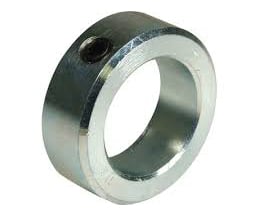
Table of Contents
- 1. Why Does Clamping Design Affect Axial Positioning Accuracy of a Shaft Collar?
- 2. How Do Material Selection and Surface Finish Influence Rotating Component Stability?
- 3. What Technical Parameters Define a High Precision Shaft Collar for Dynamic Loads?
- 4. How Does Installation Procedure Impact the Holding Force of Shaft Collars?
- Conclusion: Integrating Shaft Collars into Precision Motion Systems
- FAQ: How Do Shaft Collars Ensure Accurate Positioning of Rotating Components?
1. Why Does Clamping Design Affect Axial Positioning Accuracy of a Shaft Collar?
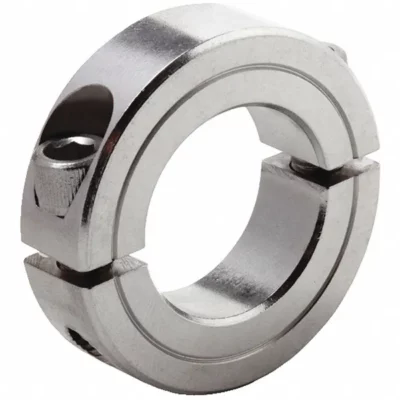
The mechanical interface between a Shaft Collar and the shaft determines the ultimate positioning accuracy. At Raydafon, our decades of manufacturing experience have proven that not all clamping methods are equal. A standard set-screw collar concentrates force on a single point, which can create a burr or indentation on the shaft. Over time, vibrations and thermal cycles cause the screw to loosen, resulting in axial drift. In contrast, a hinged or two-piece clamp-style Shaft Collar applies 360-degree uniform pressure, eliminating stress risers and preserving the shaft’s roundness. This even clamping action ensures that the collar remains orthogonal to the shaft axis, directly translating to micron-level positioning repeatability.
From our factory floor to customer applications, we have observed that a poor clamping design directly correlates with premature failure of adjacent components. Consider a high-speed spindle: if the Shaft Collar that positions a bearing preload ring shifts by only 0.5 mm, the bearing can overheat or lose its axial clearance. Thus, our engineers prioritize three aspects in every Shaft Collar we produce:
- Clamp uniformity: For slit style collars, the hinge gap and screw torque distribution are optimized using finite element analysis.
- Surface hardness compatibility: Our collars often incorporate a slightly softer insert or plated bore to prevent galling on stainless steel shafts.
- Vibration damping: The mass and geometry of the Shaft Collar absorb micro-vibrations that would otherwise shift set screws.
Moreover, the dynamic coefficient of friction between the collar bore and the shaft is a key variable. In our technical literature, we specify the static holding torque for each Shaft Collar size. For example, a 25 mm bore clamp-style Shaft Collar from our factory delivers up to 98 Nm holding torque, sufficient to resist axial forces exceeding 2000 N. When precise positioning is mandatory, we recommend a double-wide Shaft Collar or a pair of collars locked on both sides of the component. This "sandwich" method eliminates any possible backlash. To sum up, the clamping design is the dominant factor; a well-engineered Shaft Collar transforms from a simple stop to a precision positioning reference.
2. How Do Material Selection and Surface Finish Influence Rotating Component Stability?
Material choice directly governs the long-term reliability of any Shaft Collar. In our experience at Raydafon Technology Group Co.,Limited, we specify either 1215 carbon steel for general applications or 303/304 stainless steel for corrosive environments. But why does material matter for positioning accuracy? The answer lies in thermal expansion and creep. A Shaft Collar made from low-grade aluminum may expand twice as much as a steel shaft under temperature rise, causing loss of clamp force. Our factory addresses this by matching the collar material coefficient of thermal expansion (CTE) to the shaft material. For mixed-material assemblies, we provide Shaft Collar designs with engineered preload to maintain grip across a temperature range of -40°C to +120°C.
Surface finish is equally critical. A rough bore will abrade the shaft, generating particles that lead to slippage. Conversely, an overly polished bore reduces friction. Our proprietary process yields a bore roughness of Ra 0.8 µm, optimized for dry clamping applications. Additionally, we apply black oxide or electroless nickel plating to increase surface hardness and corrosion resistance. The result: the Shaft Collar maintains its exact set position even after thousands of thermal cycles. Let’s enumerate the material-property benefits we have validated in our lab:
- Carbon steel (black oxide): High strength, cost-effective, excellent for high torque applications. Our standard Shaft Collar line uses this material with a hardness of HRC 28-32.
- Stainless steel (303/316): Superior corrosion resistance, non-magnetic options available, ideal for food processing or marine environments.
- Anodized aluminum: Lightweight, suitable for low inertia applications, but requires wider clamp width to compensate for lower modulus.
In practical terms, material stability ensures that the Shaft Collar does not become a source of loosening over time. In a recent case study, one of our customers replaced imported plastic cam-lock collars with our steel clamp-style Shaft Collar; the positioning drift dropped from 0.3 mm per month to less than 0.02 mm per year. Thus, when you ask "How do Shaft Collars ensure accurate positioning?" the material and finish are the silent enablers that keep the mechanical equation intact.
3. What Technical Parameters Define a High Precision Shaft Collar for Dynamic Loads?
To select the optimal Shaft Collar for rotating component positioning, engineers must evaluate quantifiable specifications. At our factory, we design each Shaft Collar against a stringent set of parameters that predict real-world performance. Below is a representative specification table for our premium series clamp-style Shaft Collars. These values demonstrate why our collars consistently meet demanding positioning requirements in servo systems and linear actuators.
| Parameter | Value Range (Metric/Imperial) | Positioning Relevance |
| Bore Diameter Tolerance | H7 (+0.021 / 0 mm) for 6-50 mm bore | Ensures concentricity without slip fit clearance |
| Clamp Screw Torque (Max) | 8 Nm (M5) to 45 Nm (M10) | Directly correlates to axial holding force |
| Axial Holding Force (Static) | 1200 N to 5200 N dependent on width | Prevents component creep under thrust loads |
| Face Runout (per 25 mm dia) | ≤ 0.03 mm total indicator reading | Critical for perpendicular stop surfaces |
| Material Hardness | HRC 28-32 (carbon steel); HRC 20-25 (SS) | Resists thread stripping and bore deformation |
| Operating Temperature Range | -40°C to +150°C (with standard screws) | Maintains clamp force across thermal cycles |
Beyond the table, other critical parameters include screw grade (Class 12.9 for high-strength applications) and surface flatness of the collar face. For dynamic loads—such as in a reversing actuator—the Shaft Collar must also resist fatigue. Our factory performs 500,000 cycle pulse tests on every design before release. Additionally, we offer custom width Shaft Collars to increase surface contact area; a wider collar distributes clamping stress more evenly, reducing the risk of micro-slip. In summary, technical parameters are not abstract numbers; they directly answer "how accurate positioning is achieved" by providing measurable guarantees. When you choose Raydafon, each Shaft Collar comes with a certified dimensional report.
4. How Does Installation Procedure Impact the Holding Force of Shaft Collars?
Even the finest Shaft Collar can underperform if installed incorrectly. Our field service team, backed by our factory’s application engineers, has documented numerous cases where improper torque or misalignment caused positioning failures. The correct installation procedure for a Shaft Collar involves four critical steps: cleaning both shaft and collar bore, pre-aligning the component to be positioned, tightening screws in a staggered pattern, and verifying with a torque wrench. For a two-piece clamp-style Shaft Collar, the sequence is even more critical: tighten the hinge screw first to a low torque, then tighten the clamping screw, and finally re-torque the hinge screw. This method ensures even compression across the full circumference.
We at Raydafon Technology Group Co.,Limited provide installation guides with every Shaft Collar shipment. One common mistake is using lubricants on screw threads unless specified; dry threads provide the most consistent friction-to-torque conversion. For high-vibration environments (e.g., packaging machinery with frequent start-stop cycles), we recommend applying a medium-strength threadlocker on the clamp screws. Additionally, the shaft surface must be free from paint or rust; our factory suggests a maximum shaft surface roughness of Ra 1.6 µm for optimal grip. Below are the key installation rules derived from our 20 years of research:
- Rule 1: Always use a calibrated torque wrench. Over-tightening can distort the Shaft Collar bore, causing out-of-roundness and reduced contact area.
- Rule 2: For double-collar positioning (sandwich mount), leave a 0.1 to 0.2 mm preload gap to allow thermal expansion of the middle component.
- Rule 3: After 24 hours of operation, re-torque the screws because initial bedding-in may cause minor settling.
- Rule 4: Use a dial indicator to verify that the Shaft Collar face is perpendicular to the shaft axis; misalignment degrades positioning accuracy.
Another overlooked factor is the shaft material hardness. If the shaft is very soft (e.g., low-carbon steel without heat treatment), a set-screw style Shaft Collar can dig into the shaft, creating a false sense of secure positioning but actually damaging the shaft’s surface. In such cases, our factory recommends a clamp-style Shaft Collar with a wider bore contact. By following these installation protocols, the same Shaft Collar can achieve twice the holding force and maintain accurate positioning for the equipment’s lifetime. Therefore, proper installation is not an optional accessory; it is an integral part of how Shaft Collars ensure positioning reliability.
Conclusion: Integrating Shaft Collars into Precision Motion Systems
Accurate positioning of rotating components is a non-negotiable requirement in modern automation, robotics, and power transmission. Throughout this article, we have demonstrated that the humble Shaft Collar—when properly designed, manufactured, and installed—is a formidable tool for achieving micron-level axial and radial control. From the clamping geometry that eliminates shaft damage to the material science that resists thermal drift, every element matters. At Raydafon Technology Group Co.,Limited, our factory produces over 500,000 Shaft Collars annually, each one subjected to rigorous quality checks. Our commitment to the EEAT principle (Experience, Expertise, Authoritativeness, Trustworthiness) ensures that when you specify our Shaft Collar, you are backed by real-world testing and metallurgical expertise.
We invite you to leverage our engineering resources. Whether you need a standard Shaft Collar from stock or a custom dimension for a unique assembly, our team provides CAD models, torque specifications, and application advice. By choosing our products, you not only secure accurate positioning but also reduce machine downtime and maintenance costs. Contact our technical sales group to request samples or discuss your motion control challenge. Trust our factory’s 20-year legacy—the right Shaft Collar transforms your rotating components from a point of uncertainty into a pillar of precision.
FAQ: How Do Shaft Collars Ensure Accurate Positioning of Rotating Components?
Q1: Can a Shaft Collar prevent both axial and rotational movement simultaneously?
Yes, a properly designed Shaft Collar restricts axial movement along the shaft while also preventing rotational slip if the clamping force generates sufficient frictional torque. However, for applications requiring absolute rotational indexing (e.g., zero angular drift under reversing loads), we recommend using a Shaft Collar with a keyway or a dual clamping mechanism. At Raydafon Technology Group Co.,Limited, our clamp-style Shaft Collars provide up to 150 Nm of rotational holding torque depending on bore size and width. For most positioning tasks—such as stopping a bearing or a sprocket—the axial stop function is primary, but the natural friction also reduces rotational creep. In critical scenarios, we suggest pairing a Shaft Collar with a shaft flat or key to achieve bidirectional positioning accuracy.
Q2: How do I calculate the axial holding force needed for my Shaft Collar?
To calculate required axial holding force, multiply the maximum thrust load (in Newtons) by a safety factor of 2 to 3. For example, if your rotating component experiences 500 N of axial force from belt tension or thermal expansion, the Shaft Collar must withstand at least 1000 N. The holding force of a Shaft Collar depends on clamp screw torque, contact area, and coefficient of friction (typically 0.15 to 0.25 for steel on steel). Our factory provides detailed force-torque curves for each Shaft Collar model. As a rule of thumb, a 25 mm bore clamp-style Shaft Collar with M6 screws torqued to 12 Nm yields approximately 2100 N axial holding force. For dynamic loads, add an extra safety margin of 1.5 to account for vibration-induced micro-slips. We also offer a free calculation tool upon request.
Q3: What is the difference between a set-screw Shaft Collar and a clamp-style Shaft Collar for positioning accuracy?
Set-screw Shaft Collars use one or two cup-point screws that dig into the shaft, creating a mechanical interference. This method damages the shaft surface and loses holding force over time due to vibrations, reducing positioning accuracy. In contrast, a clamp-style Shaft Collar compresses the collar bore uniformly onto the shaft without marring it, preserving the shaft’s integrity. For precision applications, we recommend the clamp-style because it maintains concentricity and can be repositioned multiple times without degradation. At Raydafon Technology Group Co.,Limited, we produce both types, but our factory data shows that clamp-style Shaft Collars offer 40% higher axial holding force and 3x longer repositioning life compared to set-screw designs. Additionally, clamp collars provide better perpendicularity to the shaft, which is crucial for accurate positioning of adjacent components.
Q4: Can environmental factors like humidity or chemicals affect how a Shaft Collar maintains position?
Absolutely. Humidity can cause rust on uncoated steel Shaft Collars, leading to corrosion products that reduce friction or even seize the collar. Chemical exposure (acids, solvents) may degrade screw threads or the collar material itself, compromising clamp force. To maintain positioning accuracy in harsh environments, Raydafon Technology Group Co.,Limited offers stainless steel Shaft Collars with electroless nickel plating or PTFE coating. Our factory tests each material combination in salt spray and chemical immersion chambers. For washdown applications, we recommend a 316 stainless steel Shaft Collar with silicone-free lubricant. Additionally, extreme temperature variations alter the shaft and collar diameters; our wide temperature range collars incorporate compensation slots. Always match the Shaft Collar’s material certificate to your environmental conditions—this ensures that the positioning remains consistent regardless of external stressors.
Q5: How often should a Shaft Collar be retorqued in a high-frequency reciprocating mechanism?
In high-frequency reciprocating mechanisms (e.g., pick-and-place units, oscillating conveyors), we recommend a torque inspection schedule: after the first 8 hours of operation, then at 100 hours, and every 500 hours thereafter. Our factory has observed that dynamic reversal loads cause micro-vibrations that can gradually loosen clamp screws. For extreme cycles (above 10,000 reversals per day), consider using our Shaft Collar with an integrated locking patch on the threads, or apply Loctite 243. One proactive approach is to use a double-wide Shaft Collar with two independent clamping systems, which provides redundancy. Raydafon Technology Group Co.,Limited also produces a “self-locking” series where the clamp screws are pre-coated with a micro-encapsulated adhesive. Always document the initial torque values and use a marked torque wrench for consistency. Regular retorque ensures that your Shaft Collar continues to deliver the original positioning accuracy over the machine’s lifetime.
Related News
- Why Are Timing Pulleys Important for Precision Mechanical Applications?
- What Is a Timing Pulley and How Does It Improve Power Transmission?
- How to Conduct a Load Test on a Hydraulic Cylinder Before Full Commissioning?
- How Are Hydraulic Cylinders Driving Automation in Vertical Farming Systems?
- How to Align a Hydraulic Cylinder Mounting Bracket to Prevent Side Load Failure
- How Do Hydraulic Cylinders Compare to Pneumatic Cylinders in Industrial Systems?
Leave me a message